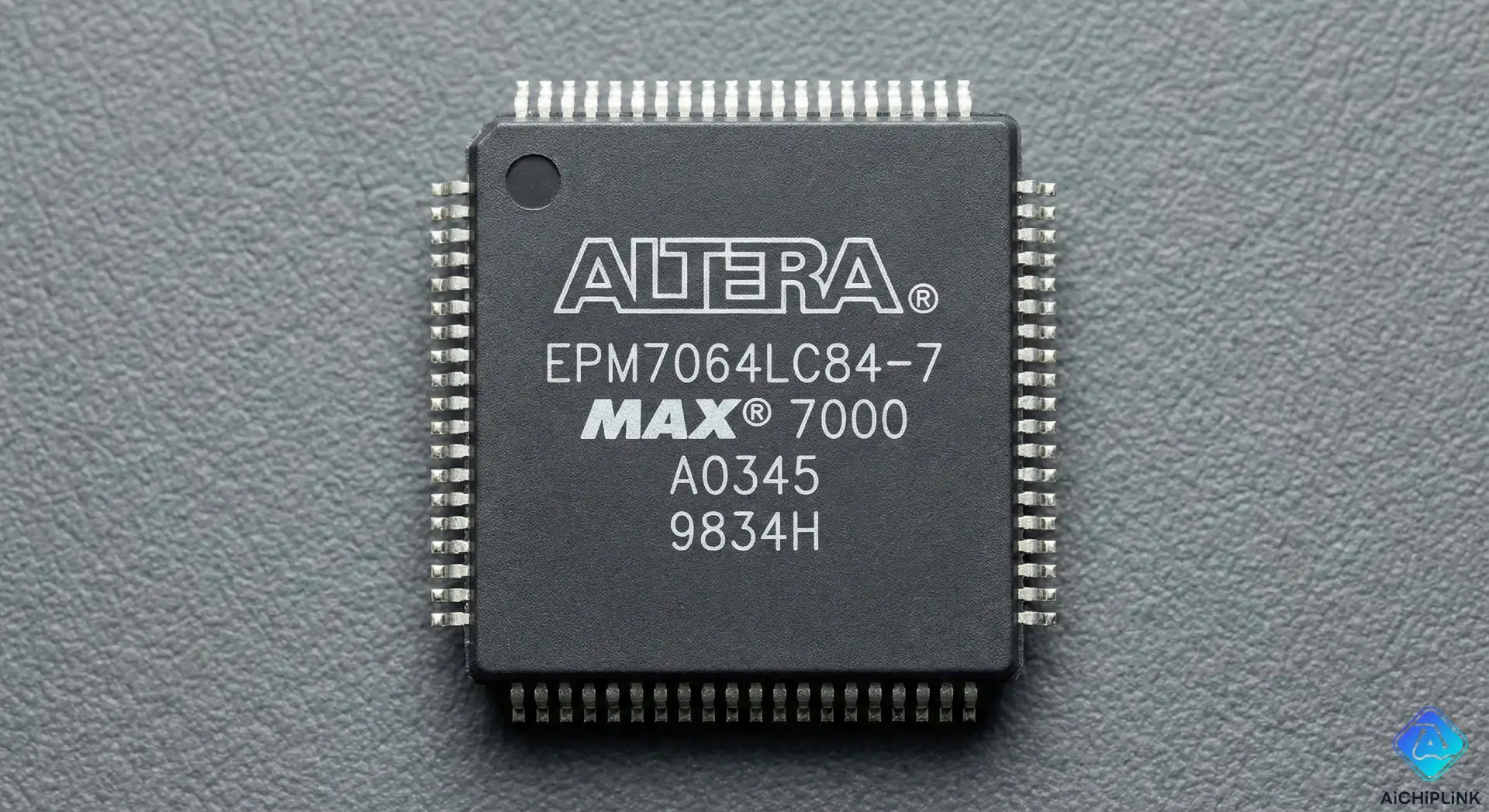
EPM7064LC84-7 CPLD Complete Guide: Datasheet, PLCC84 Pinout, and Programming
In the world of legacy industrial electronics and retro-computing, the Altera (now Intel) EPM7064LC84-7 remains a critical component. Part of the classic MAX 7000 family, this Complex Programmable Logic Device (CPLD) is renowned for its robustness, true 5V operation, and deterministic timing.
However, working with the EPM7064LC84-7 in the modern era presents challenges—specifically regarding programming hardware and finding authentic stock. This guide covers the essential technical details, the critical distinction between the "S" and "Non-S" versions, and where to source these components today.
Table of Contents
- EPM7064LC84-7 Datasheet & Technical Specifications
- PLCC84 Package Pinout & PCB Integration
- Programming the EPM7064 (Non-S) Series
- Architecture & Application Examples
- Conclusion
EPM7064LC84-7 Datasheet & Technical Specifications
The EPM7064LC84-7 is a high-performance, EEPROM-based CPLD. The part number breaks down as follows:
- EPM70: MAX 7000 Family.
- 64: 64 Macrocells.
- L: PLCC (Plastic Leaded Chip Carrier) package.
- C: Commercial Temperature range.
- 84: 84 Pins.
- -7: 7.5 ns propagation delay (Speed Grade).
Key Specifications Table
| Feature | Specification |
|---|---|
| Logic Density | 1,250 Usable Gates |
| Macrocells | 64 |
| Logic Array Blocks (LABs) | 4 |
| Max User I/O | 68 |
| Speed Grade ($t_{PD}$) | 7.5 ns |
| Operating Voltage | 5.0V |
| Package | 84-Pin PLCC |
EPM7064 vs. EPM7064S: The Programming Difference
This is the most critical section for designers.
There are two variations of this chip: the EPM7064 (Standard) and EPM7064S (ISP capable).
- EPM7064LC84-7 (Non-S): Does NOT support In-System Programming (ISP) via JTAG. To program this chip, you must remove it from the board and place it in a socketed high-voltage programmer.
- EPM7064SLC84-7 (S-Series): Supports ISP via JTAG (IEEE 1149.1).
Warning: If your board has a JTAG header but uses the EPM7064 (non-S), you cannot program the chip on the board.
Obsolescence & Market Availability
The MAX 7000 series is classified as a legacy product. Sourcing these chips requires vigilance to avoid used or counterfeit parts (often remarked).
[Check Stock for EPM7064LC84-7 at Aichiplink] to find authentic inventory from verified global distributors.
PLCC84 Package Pinout & PCB Integration
The PLCC84 package is a square, surface-mount package with J-leads on all four sides. It is often used with a socket (Through-hole or SMT) to allow for easy chip removal—essential for the non-S version of this chip.
Understanding the PLCC84 Footprint
- Pitch: 1.27 mm (50 mil).
- Socketing: Highly recommended for the EPM7064LC84-7 to facilitate programming in an external device.
Power & Ground Pin Distribution
Proper decoupling is vital for the 7.5ns speed grade to prevent ground bounce.
- VCCINT (5V Core): Pins 3, 43.
- VCCIO (I/O Power): Pins 13, 26, 38, 53, 66, 78.
- GND: Pins 6, 19, 31, 47, 62, 73.
- (Always verify with the official datasheet as revisions may vary).
Programming the EPM7064 (Non-S) Series
Programming the EPM7064LC84-7 is distinct from modern FPGAs.
Why JTAG Won't Work
Unlike the "S" series, the standard EPM7064 lacks the JTAG state machine logic. It uses a parallel high-voltage programming algorithm.
- Required Hardware: You need a universal programmer (e.g., Data I/O, SuperPro, or the legacy Altera Master Programming Unit (MPU) with a PLCC84 adapter).
- Process: Compile code -> Generate POF (Programmer Object File) -> Insert Chip into Programmer Socket -> Burn.
Supported Software: Quartus II Legacy
Modern versions of Quartus Prime (v13.1+) dropped support for the MAX 7000 series.
- Recommended Version: Quartus II Web Edition 9.1 (Last version to fully support the non-S MAX 7000 properly without complex workarounds).
- File Format: Ensure you generate a .POF file, not just a .SOF (SRAM Object File) or .JED.
Architecture & Application Examples
5V Logic Interface
The EPM7064LC84-7 is a native 5V device, making it perfect for:
- Retro-computing: Interfacing with 5V CPUs like the Z80, 6502, or 8051 without level shifters.
- Industrial Repair: Replacing glue logic in older PLC modules where 3.3V translation is not feasible.
Replacement Strategies
If the EPM7064LC84-7 is unobtainable, consider the EPM7064SLC84 (S-Series).
- Pros: Pin-compatible for power/ground/IO in most cases.
- Cons: Requires adding a JTAG header to your board design if you wish to utilize ISP features, but can still be programmed externally.
Conclusion
The EPM7064LC84-7 is a testament to the longevity of the MAX 7000 architecture. While its lack of JTAG support makes it trickier to use in modern workflows compared to the S-series, its 5V robustness keeps it in demand for maintenance and specialized designs.
Looking for hard-to-find CPLDs?
Don't risk your project with unverified components. Search Aichiplink.com for available stock of EPM7064LC84-7 and other legacy Altera programmable logic devices. We ensure quality and authenticity for critical supply chains.

Written by Jack Elliott from AIChipLink.
AIChipLink, one of the fastest-growing global independent electronic components distributors in the world, offers millions of products from thousands of manufacturers, and many of our in-stock parts is available to ship same day.
We mainly source and distribute integrated circuit (IC) products of brands such as Broadcom, Microchip, Texas Instruments, Infineon, NXP, Analog Devices, Qualcomm, Intel, etc., which are widely used in communication & network, telecom, industrial control, new energy and automotive electronics.
Empowered by AI, Linked to the Future. Get started on AIChipLink.com and submit your RFQ online today!
Frequently Asked Questions
Is the EPM7064LC84-7 pin-compatible with the EPM7064SLC84-7?
Yes, they are generally pin-compatible regarding Power, Ground, and I/O pins. However, the S-series utilizes specific pins for JTAG (TCK, TMS, TDI, TDO) which function as regular I/O on the non-S version if JTAG is disabled.
Can I use a USB-Blaster to program the EPM7064LC84-7?
**No.** The USB-Blaster is a JTAG/Active Serial tool. The EPM7064LC84-7 (non-S) does not support JTAG programming. You need a third-party universal programmer with a PLCC84 socket.
What is the difference between speed grades -7, -10, and -15?
The number represents the propagation delay ($t_{PD}$) in nanoseconds. The **-7** (7.5ns) is faster than the -10 (10ns) or -15 (15ns). You can usually replace a slower chip with a faster one (e.g., replace -15 with -7), but not vice-versa without timing analysis.
Does this chip require an external configuration memory?
No. The MAX 7000 series uses CPLD technology (EEPROM-based), meaning it is **non-volatile**. It retains its configuration when power is removed, allowing for "instant-on" functionality upon power-up.
Where can I find the datasheet for the EPM7064LC84-7?
The original Altera MAX 7000 datasheet is archived by Intel. You can also view the full specification and pinout map directly on the product detail page at Aichiplink.