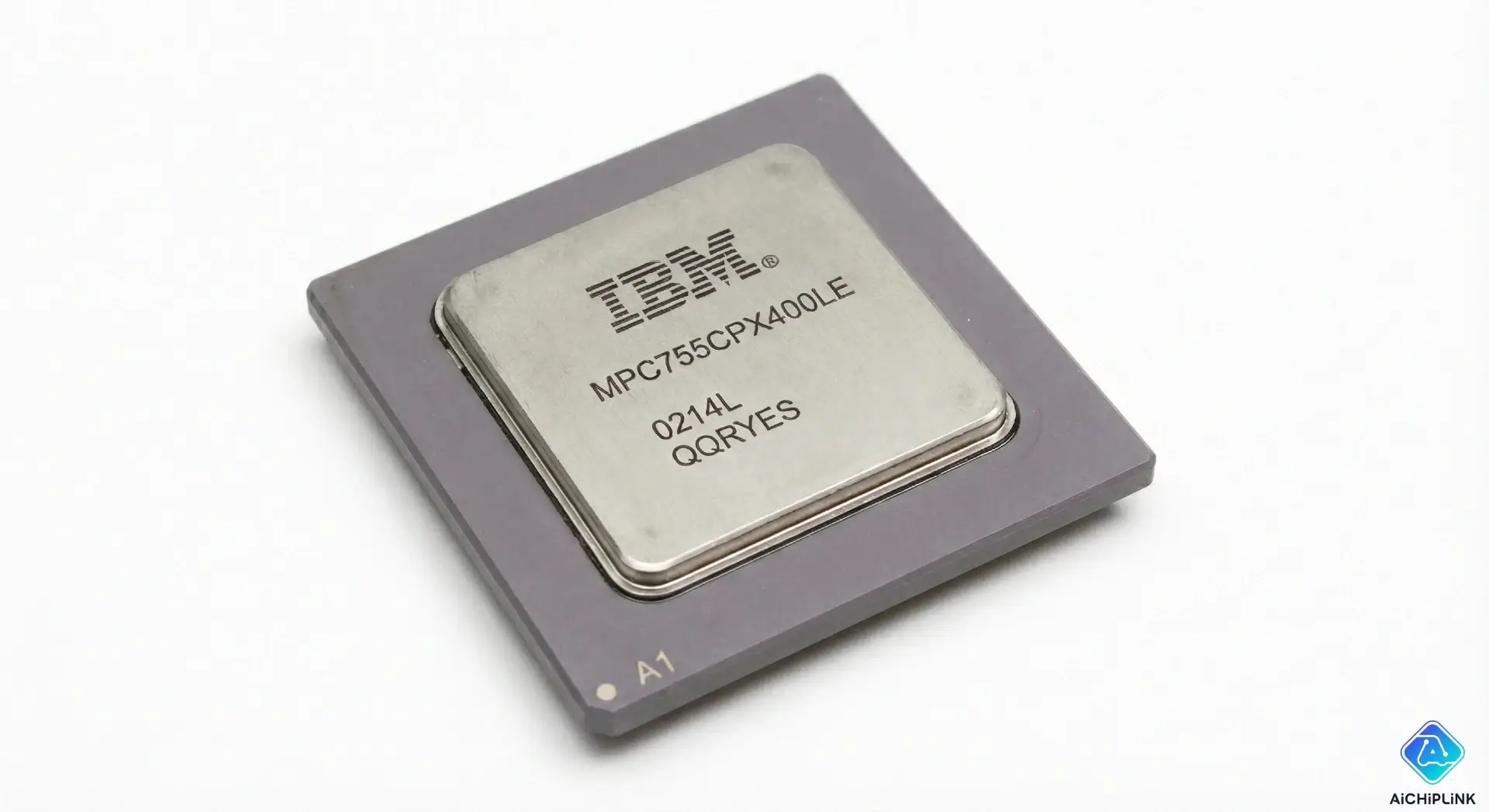
Table of Contents
- 1.0 What is the MPC755CPX400LE? (Datasheet Explained)
- 1.1 The PowerPC 7xx Family: The Embedded "G3" Revolution
- 1.2 Decoding the Part Number: MPC755CPX400LE
- 1.3 Key Specifications Summary
- 2.0 Technical Deep Dive: Architecture & Performance
- 2.1 Superscalar RISC Core & Cache
- 2.2 Low Power Features: Dynamic Power Management
- 2.3 MPC755 vs. MPC750: What Changed?
- 3.0 MPC755CPX400LE Pinout and Package (360-BGA)
- 3.1 The 360-Pin Ball Grid Array (BGA)
- 3.2 Key Interface Signals: 60x Bus and L2 Cache
- 4.0 Legacy Applications and Maintenance
- 4.1 Where is the MPC755 Used?
- 4.2 Obsolescence Strategy: Sourcing and Replacement
In the history of embedded computing, few architectures have left a mark quite like the PowerPC G3. Before ARM dominated the world, the PowerPC 7xx series was the engine behind everything from networking routers to Apple computers and deep-space avionics. The MPC755CPX400LE is a prime example of this legacy: a 32-bit RISC microprocessor designed by Motorola (later Freescale/NXP) to deliver high performance with remarkably low power consumption.
While no longer used in new consumer designs, the MPC755CPX400LE remains a critical component in the MRO (Maintenance, Repair, and Operations) sector. Industrial controllers, telecommunications infrastructure, and aerospace systems built in the late 90s and early 2000s often rely on this specific chip to function.
If you are an engineer tasked with maintaining these long-lifecycle systems, understanding this processor is not optional—it's essential. This guide provides a comprehensive technical analysis of the MPC755 datasheet, specifications, and replacement considerations.
1.0 What is the MPC755CPX400LE? (Datasheet Explained)
The MPC755CPX400LE is a 32-bit embedded microprocessor based on the PowerPC architecture. It is a low-power version of the MPC750 (the famous "G3" chip), optimized for embedded applications where thermal management and power efficiency were more critical than raw clock speed.
1.1 The PowerPC 7xx Family: The Embedded "G3" Revolution
The MPC755 belongs to the MPC7xx family. These processors were revolutionary because they brought **superscalar performance** (executing multiple instructions per clock cycle) to embedded systems at a reasonable price point. They featured a high-performance **60x system bus** and a dedicated L2 cache interface, allowing for high-bandwidth data movement critical for networking.1.2 Decoding the Part Number: MPC755CPX400LE
Every character in the part number defines a specific capability. Here is the breakdown: * **MPC755:** Device Family (PowerPC 755 RISC Microprocessor). * **C:** Specification revision (often denotes specific electrical characteristics). * **PX:** Package Type. **PX** stands for **Plastic Ball Grid Array (PBGA)**. * **400:** Speed Grade. The processor runs at **400 MHz**. * **LE:** Revision/Process code. Often indicates **Low Energy** or a specific voltage tolerance (typically 2.0V core).1.3 Key Specifications Summary
Here are the core metrics from the **MPC755 datasheet**:| Feature | Specification |
|---|---|
| Architecture | 32-bit PowerPC RISC |
| Clock Speed | 400 MHz |
| L1 Cache | 32KB Instruction / 32KB Data |
| L2 Cache Interface | Dedicated, up to 1MB backside L2 |
| Bus Interface | 60x Bus (64-bit data, 32-bit address) |
| Core Voltage | 2.0V (nominal) |
| I/O Voltage | 3.3V |
| Package | 360-pin PBGA |
| Power | ~3.0 Watts typical at 400 MHz |
2.0 Technical Deep Dive: Architecture & Performance
The MPC755 wasn't just a "shrunk" MPC750; it was refined for the embedded market.
2.1 Superscalar RISC Core & Cache
The MPC755 features a superscalar core capable of issuing **three instructions per clock cycle** to six independent execution units (Integer, Floating Point, Branch Processing, Load/Store, System Register). * **L1 Cache:** It includes 32KB of instruction cache and 32KB of data cache on-chip. * **L2 Cache Controller:** Unlike many modern MCUs, the MPC755 has a dedicated **backside L2 cache interface**. This allows the CPU to access external L2 cache memory directly without clogging the main system bus, significantly improving performance in data-heavy applications.2.2 Low Power Features: Dynamic Power Management
The "L" in the series often alludes to its low-power capabilities. The MPC755 introduced **Dynamic Power Management**, which allowed the processor to automatically power down execution units that were not in use. It also supported sleep modes (Nap, Doze, and Sleep) that reduced power consumption to milliwatts during idle periods—a game-changer for fanless industrial enclosures.2.3 MPC755 vs. MPC750: What Changed?
Why choose the 755 over the 750? * **Die Shrink:** The 755 was built on a smaller process node (0.22µm or smaller), reducing power and cost. * **Voltage:** The 755 typically operates at a lower core voltage (2.0V vs 2.5V/3.3V of older 750s). * **Thermal:** The 755 runs significantly cooler, often requiring only a passive heatsink.3.0 MPC755CPX400LE Pinout and Package (360-BGA)
The MPC755CPX400LE uses a 360-pin Plastic Ball Grid Array (PBGA) package. This high-density packaging was necessary to support the 64-bit data bus and the dedicated L2 cache interface.
3.1 The 360-Pin Ball Grid Array (BGA)
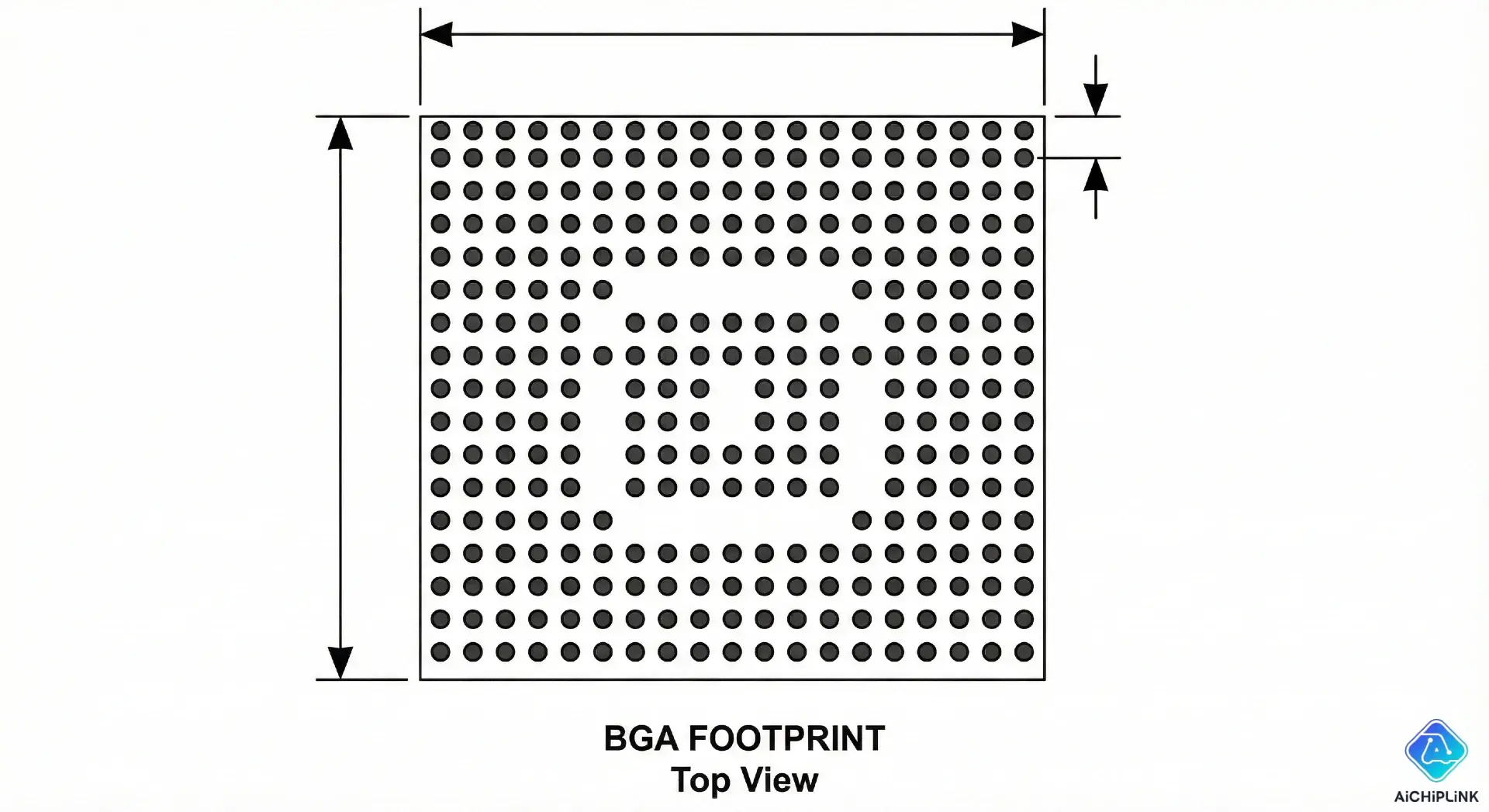
- Mounting: Surface Mount Technology (SMT).
- Ball Pitch: 1.27 mm (Standard BGA pitch, relatively easier to rework than modern fine-pitch BGAs).
- Thermal: The PBGA package allows for heat dissipation through the top surface (to a heatsink) and through the solder balls into the PCB ground plane.
3.2 Key Interface Signals: 60x Bus and L2 Cache
When troubleshooting a board with this processor, you are usually looking at two main buses: 1. **System Bus (60x Bus):** Pins labeled `A[0:31]` (Address) and `DH[0:31]/DL[0:31]` (Data). This connects the CPU to the memory controller and main peripherals. 2. **L2 Cache Bus:** Pins labeled `L2ADDR`, `L2DATA`, and `L2ZZ`. Check these for activity if the system fails to boot or is unstable, as L2 cache failure is a common aging issue.4.0 Legacy Applications and Maintenance
4.1 Where is the MPC755 Used?
You will find this processor in high-reliability equipment that was built to last 20+ years: * **Telecommunications:** Core routers, switches, and DSLAMs from the early 2000s (e.g., Cisco, Lucent gear). * **Aerospace & Defense:** Flight control computers and radar signal processors due to the architecture's reliability. * **Industrial Automation:** High-end CNC machines and robotic controllers. * **Printers:** High-speed office laser printers and plotters.4.2 Obsolescence Strategy: Sourcing and Replacement
The **MPC755CPX400LE** is an **obsolete (End-of-Life)** component. NXP (Freescale) no longer manufactures it. * **Sourcing:** You must rely on specialized distributors of legacy components. * **Risks:** Beware of counterfeit chips (remarked lower-speed parts). Always source from reputable vendors who perform X-ray and decapsulation testing. * **BGA Rework:** Replacing this chip requires a BGA rework station. It cannot be done with a soldering iron. Ensure your repair facility has the correct stencil and reflow profile for a 360-pin PBGA.In Conclusion
The MPC755CPX400LE is more than just a silicon chip; it is a foundational piece of the embedded computing history that still powers critical infrastructure today. Whether you are repairing a telecom switch or maintaining an avionics system, understanding the specific voltage, pinout, and architectural needs of this PowerPC G3 veteran is the key to success.
If you are facing a line-down situation due to this obsolete processor, do not risk your equipment with unverified sources. Browse our catalog of legacy processors or contact AichipLink today to secure the genuine components you need to keep your systems running.

Written by Jack Elliott from AIChipLink.
AIChipLink, one of the fastest-growing global independent electronic components distributors in the world, offers millions of products from thousands of manufacturers, and many of our in-stock parts is available to ship same day.
We mainly source and distribute integrated circuit (IC) products of brands such as Broadcom, Microchip, Texas Instruments, Infineon, NXP, Analog Devices, Qualcomm, Intel, etc., which are widely used in communication & network, telecom, industrial control, new energy and automotive electronics.
Empowered by AI, Linked to the Future. Get started on AIChipLink.com and submit your RFQ online today!
Frequently Asked Questions
What is the MPC755CPX400LE?
The **MPC755CPX400LE** is a 32-bit PowerPC RISC microprocessor running at 400 MHz. It is part of the Motorola/Freescale (now NXP) MPC7xx family, widely used in legacy industrial and networking equipment. It features a 360-pin BGA package and low-power operation.
Is the MPC755 obsolete?
Yes, the **MPC755** family is obsolete and End-of-Life (EOL). It is not recommended for new designs. However, it is actively sourced for the maintenance and repair (MRO) of existing long-lifecycle systems.
Can I replace an MPC755 with an MPC750?
Generally, no. While they share the same architecture, the **MPC755** typically uses a lower core voltage (2.0V vs 2.5V/3.3V of older 750s) and has different thermal characteristics. A direct drop-in replacement requires verifying the motherboard's voltage regulator settings and BIOS support.
What is the bus speed of the MPC755CPX400LE?
The processor supports a **60x system bus** speed of up to 100 MHz, depending on the clock multiplier settings configured on the motherboard.
Where can I buy the MPC755CPX400LE?
Since the part is obsolete, you cannot buy it from standard franchised distributors. You need to contact specialized legacy component suppliers. Check AichipLink's inventory for genuine, tested stock of this hard-to-find processor.

