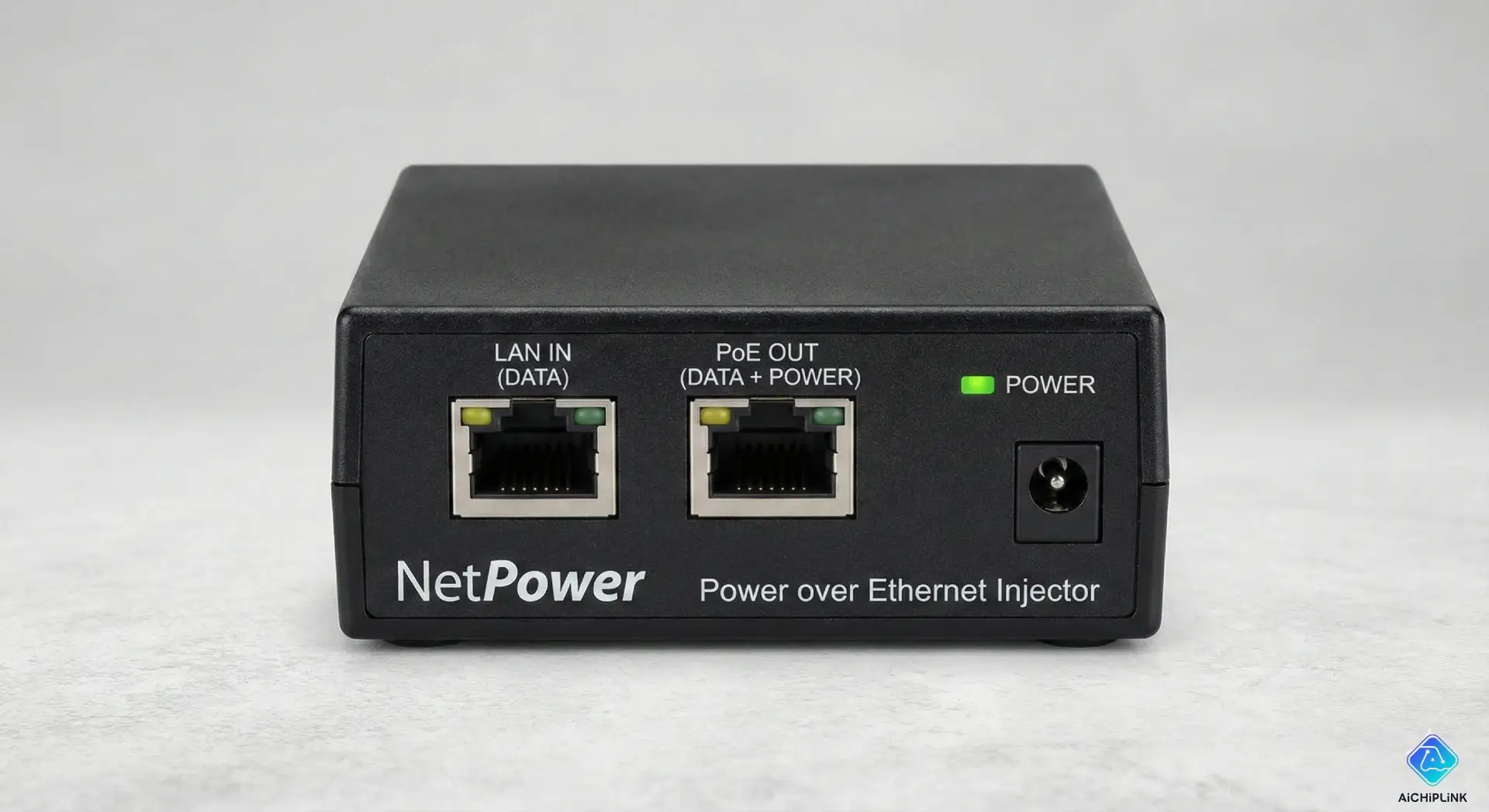
In the world of networking, few technologies have been as transformative as Power over Ethernet (PoE). It has quietly revolutionized how we deploy devices, turning the humble Ethernet cable from a simple data carrier into a dual-purpose lifeline.
If you’ve ever installed a security camera without needing a nearby power outlet or deployed a Wi-Fi access point in a ceiling void, you’ve experienced the utility of PoE. But how exactly does it work, and what are the differences between the various standards like PoE+ and PoE++?
This guide breaks down everything you need to know about PoE technology.
What is Power over Ethernet (PoE)?
Power over Ethernet (PoE) is a technology that allows network cables to carry electrical power.
Traditionally, networked devices required two connections:
- A network cable (like Cat5e or Cat6) for data.
- A power cord plugged into a wall outlet for electricity.
PoE combines these into a single cable. It allows the data connection to simultaneously provide the electrical current required to operate the device.
Key Terminology
To understand PoE, you need to know the two main players in the connection:
- PSE (Power Sourcing Equipment): The device that sends the power. This is typically a PoE-enabled network switch or a PoE injector.
- PD (Powered Device): The device that receives the power. Examples include IP cameras, VoIP phones, and Wireless Access Points (WAPs).
How Does PoE Work?
A standard Ethernet cable consists of four twisted pairs of copper wires. PoE utilizes these copper pairs to transmit electrical current.
The Handshake: Ensuring Safety
One of the most common myths about PoE is that it will "fry" non-PoE devices if you plug them in. This is false.
Standard PoE is intelligent. Before sending any significant power, the PSE (switch) performs a safety check called a handshake or negotiation:
- Detection: The switch sends a low-voltage pulse to check for a specific resistance (25 kΩ) in the connected device. If it detects this signature, it knows the device is PoE-compatible. If not, it sends data only, protecting your laptop or standard router.
- Classification: Once detected, the switch checks how much power the device needs (its "Class"). This allows the switch to allocate the correct power budget.
- Operation: Only after these steps are successful does the switch deliver the full operating voltage (usually 48V DC).
Modes of Transmission
Electricity can be sent over the cable in different ways, often referred to as Modes:
- Mode A (Endspan): Power and data are sent over the same pairs of wires (pins 1/2 and 3/6). This is common with switches that have built-in PoE.
- Mode B (Midspan): Power is sent over the spare pairs of wires (pins 4/5 and 7/8) that typically aren't used for 10/100 Mbps data.
- 4-Pair PoE: Used for high-power standards (PoE++), this uses all four pairs of wires to transmit power, maximizing delivery for power-hungry devices like laptops or PTZ cameras.
PoE Standards Explained: From PoE to PoE++
Not all PoE is created equal. As devices have become more powerful, the IEEE (Institute of Electrical and Electronics Engineers) has released new standards to keep up.
| Standard | Known As | IEEE Designation | Power at Source (Switch) | Power at Device (PD) | Supported Devices |
|---|---|---|---|---|---|
| PoE | Type 1 | 802.3af | 15.4 W | ~12.95 W | VoIP phones, basic static IP cameras |
| PoE+ | Type 2 | 802.3at | 30 W | ~25.5 W | Wi-Fi 5/6 APs, PTZ cameras with heaters |
| PoE++ | Type 3 | 802.3bt | 60 W | ~51 W | Video conferencing gear, multi-radio APs |
| PoE++ | Type 4 | 802.3bt | 100 W | ~71-90 W | Laptops, large TVs, high-power LED lighting |
Note: Power at the device is always lower than at the source due to resistance and power loss over the length of the cable.
Why Use PoE? The Key Benefits
Why has the industry shifted so heavily toward PoE?
1. Cost Savings
PoE eliminates the need to install AC power outlets at every device location. You don't need to hire an electrician to run high-voltage wiring to the ceiling for an access point; you just run a network cable.
2. Flexibility and Placement
Without being tethered to a wall outlet, devices can be placed exactly where they are needed most—high on walls, deep inside false ceilings, or outdoors.
3. Reliability and Safety
PoE delivers low-voltage DC power, which is safer to handle than high-voltage AC power. Furthermore, if your PoE switch is connected to an Uninterruptible Power Supply (UPS), your entire network of cameras and phones will stay online during a power outage.
4. Centralized Control
A managed PoE switch allows you to power cycle devices remotely. If a camera freezes, you can reboot it from your desk by simply toggling the PoE power on that port, rather than climbing a ladder to unplug it.
Common PoE Devices
While it started with phones, PoE now powers a vast ecosystem of IoT (Internet of Things) devices:
- VoIP Phones: The original use case.
- IP Security Cameras: Both static and Pan-Tilt-Zoom (PTZ).
- Wireless Access Points: From home mesh nodes to enterprise stadium Wi-Fi.
- Access Control: Smart door locks and badge scanners.
- Smart Lighting: LED fixtures that are powered and controlled via Ethernet.
- Audio Systems: IP speakers and paging systems.
- Digital Signage & Kiosks: Tablets and Point of Sale (PoS) systems.
Conclusion
Power over Ethernet is more than just a convenient way to reduce cable clutter. It is a fundamental building block of modern smart buildings and resilient networks. By understanding the different standards and how the technology works, you can ensure you choose the right equipment to power your network efficiently and safely.

Written by Jack Elliott from AIChipLink.
AIChipLink, one of the fastest-growing global independent electronic components distributors in the world, offers millions of products from thousands of manufacturers, and many of our in-stock parts is available to ship same day.
We mainly source and distribute integrated circuit (IC) products of brands such as Broadcom, Microchip, Texas Instruments, Infineon, NXP, Analog Devices, Qualcomm, Intel, etc., which are widely used in communication & network, telecom, industrial control, new energy and automotive electronics.
Empowered by AI, Linked to the Future. Get started on AIChipLink.com and submit your RFQ online today!
Frequently Asked Questions
Is Power over Ethernet (PoE) safe for non-PoE devices?
Yes. Standard PoE is designed with a built-in detection and negotiation process. A PoE switch only delivers power after it detects a PoE-compatible device. If the connected device does not support PoE, the switch will transmit data only, preventing damage to non-PoE equipment.
What is the maximum distance for PoE power and data transmission?
PoE follows standard Ethernet distance limits, which is up to 100 meters (328 feet) using Cat5e or higher cables. This includes both data and power delivery. Beyond this distance, PoE extenders or fiber-based solutions are required.
What is the difference between PoE, PoE+, and PoE++?
The main difference is the amount of power delivered. · PoE (802.3af) supplies up to ~12.95 W to the device. · PoE+ (802.3at) delivers up to ~25.5 W. · PoE++ (802.3bt) supports high-power devices, offering up to 60 W (Type 3) or 100 W (Type 4) at the switch. Higher standards are backward compatible with lower-power devices.
Do I need a special Ethernet cable for PoE?
In most cases, Cat5e, Cat6, or Cat6a cables are sufficient for PoE applications. For higher-power PoE++ deployments or long cable runs, Cat6 or Cat6a is recommended to reduce power loss, heat buildup, and voltage drop.
Can PoE devices be powered during a power outage?
Yes, if the PoE switch or injector is connected to a UPS (Uninterruptible Power Supply). This allows PoE-powered devices like IP cameras, VoIP phones, and access points to continue operating during power outages, improving network reliability and security.

.png&w=256&q=75)


