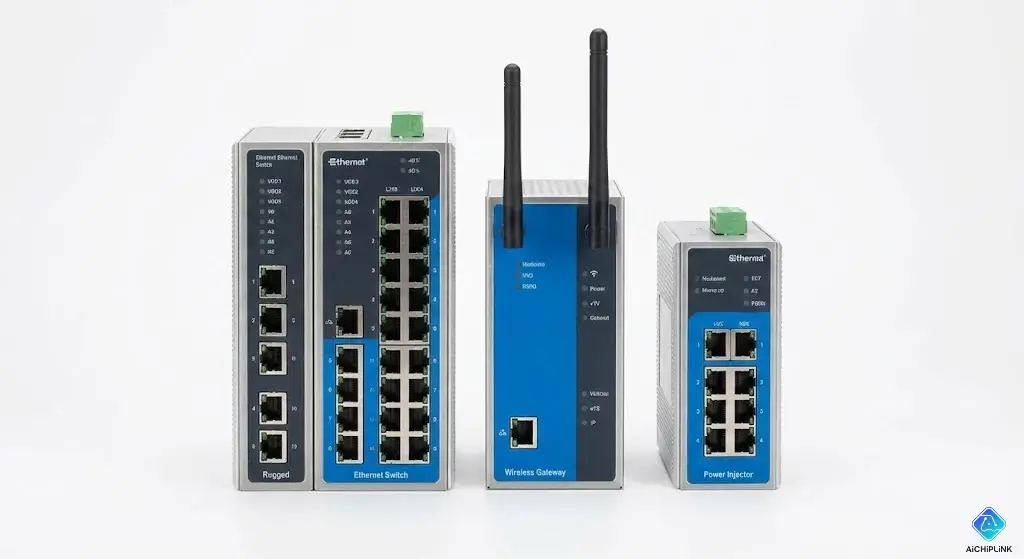
 In the comfort of an air-conditioned server room, standard networking gear works perfectly. But move that same equipment to a factory floor, an oil rig, or a traffic control box, and it won't last a week.
Industrial Network Devices are the unsung heroes of the IIoT (Industrial Internet of Things). They connect the sensors, PLCs, and cameras that run our world, but they are built to survive conditions that would destroy consumer electronics.
This guide breaks down the core components—Rugged Switches and Media Converters—and explains why "Industrial Grade" is more than just a marketing term.
1. What Defines an "Industrial" Network Device?
It comes down to three factors: Environment, Reliability, and Power.
The Environment Factor
Commercial switches are rated for 0°C to 40°C. Industrial devices typically operate from -40°C to 75°C. They use high-grade components (like industrial capacitors) that won't fail in freezing cold or baking heat.
Ruggedization
- Fanless Design: Fans are the first thing to fail in dusty environments. Industrial switches use metal casings (heatsinks) for passive cooling.
- IP Ratings: From IP30 (protected against tools) to IP67 (waterproof/dustproof), ensuring the device survives dust, metal shavings, and moisture.
- EMI Shielding: Factory floors are full of electrical noise from large motors. Industrial devices have strong shielding to prevent data loss.
2. Industrial Ethernet Switches: The Backbone of OT
The switch is the central hub of your network. In industrial settings, you have two main choices:
Unmanaged Switches: Simple Connectivity
These are "Plug-and-Play" devices. They have no configuration interface.
- Best For: Connecting a few sensors or a local machine network where simplicity is key.
- Cost: Low.
Managed Switches: Control & Redundancy
These allow you to configure, monitor, and manage the network.
- VLANs: Separate critical control traffic (PLC) from non-critical traffic (Webcams) for security and speed.
- Redundancy: Protocols like Rapid Ring or RSTP create a loop. If one cable is cut, the switch reroutes traffic in milliseconds (often <20ms), preventing production stops.
- SNMP: Allows IT managers to monitor the health of the switch remotely.
3. Media Converters: Extending the Reach
Ethernet over copper cable (RJ45) has a hard limit: 100 meters. In a sprawling warehouse or along a railway line, this isn't enough.
Industrial Media Converters solve this by converting electrical signals to light (Fiber Optic).
- Distance: Extend your network up to 20km or more using Single-mode fiber.
- Noise Immunity: Fiber is immune to Electromagnetic Interference (EMI). You can run fiber right next to a high-voltage power cable without data corruption.
4. Critical Use Cases
Factory Automation
On a car assembly line, vibration is constant. Industrial switches with DIN-Rail mounts and vibration-resistant connectors (like M12) ensure that the PLCs controlling the robots never lose connection. Redundant power inputs mean that if one 24V DC supply dies, the backup kicks in instantly.
Outdoor Surveillance & Smart Cities
Security cameras are often mounted on light poles, exposed to rain and summer heat.
- Solution: Industrial PoE (Power over Ethernet) Switches. They provide both data and power (up to 90W for PTZ cameras) over a single cable, simplifying installation.
Transportation (Rail & Bus)
Trains are harsh environments with extreme vibration and unstable power.
- Standard: Look for EN 50155 certification, which guarantees the switch can handle the shock and vibration of rolling stock.
5. Conclusion
Choosing between commercial and industrial network devices is a choice between upfront cost and long-term reliability. While a commercial switch might be cheaper today, a single hour of downtime on a production line can cost thousands of dollars. Industrial Network Devices—Rugged Switches and Media Converters—are the insurance policy that keeps your critical infrastructure running, no matter the conditions.
Building a Rugged Network? Whether you need a simple DIN-Rail switch or a complex fiber backbone, selecting the right components is critical. Visit Aichiplink.com to search for Industrial Ethernet Switches, Media Converters, and other rugged networking gear.

Written by Jack Elliott from AIChipLink.
AIChipLink, one of the fastest-growing global independent electronic components distributors in the world, offers millions of products from thousands of manufacturers, and many of our in-stock parts is available to ship same day.
We mainly source and distribute integrated circuit (IC) products of brands such as Broadcom, Microchip, Texas Instruments, Infineon, NXP, Analog Devices, Qualcomm, Intel, etc., which are widely used in communication & network, telecom, industrial control, new energy and automotive electronics.
Empowered by AI, Linked to the Future. Get started on AIChipLink.com and submit your RFQ online today!
Frequently Asked Questions
What is the difference between industrial and commercial network devices?
Industrial devices are built for harsh environments, offering wider temperature ranges, EMI protection, and higher reliability.
Why are industrial Ethernet switches usually fanless?
Fanless designs reduce failure points and prevent dust intake, making them more reliable in dusty and vibrating environments.
When should a media converter be used?
Use a media converter when Ethernet cable distance exceeds 100 meters or when EMI immunity is required using fiber optic links.
Are industrial switches suitable for outdoor use?
Yes. Many industrial switches support wide temperatures, rugged enclosures, and IP-rated protection for outdoor deployments.
Do industrial network devices support redundancy?
Managed industrial switches support ring and rapid recovery protocols, enabling fast failover to prevent network downtime.