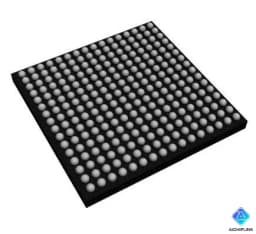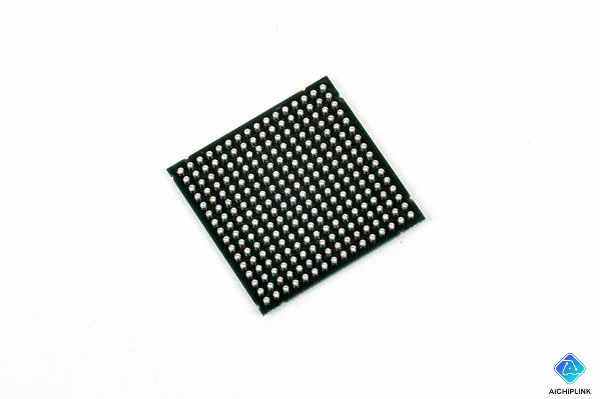
In the world of modern FPGAs running at 0.8V, the Xilinx XC95288XL-10FG256C seems like a relic. Yet, it remains one of the most sought-after components for industrial repair and legacy system design.
Why? Because it possesses a superpower that modern chips lack: 5V Tolerance.
As part of the XC9500XL family, this CPLD bridges the gap between old-school 5V TTL logic and modern 3.3V systems. If you are maintaining telecom equipment or designing a robust interface board, this is likely the chip you need.
This guide decodes its specs, solves the software compatibility puzzle, and warns you about the specific soldering requirements for the "FG" package.
Table of Contents
- Decoding the Part Number: FG vs. FGG
- Technical Specs: The 5V Advantage
- Software Compatibility: The ISE Requirement
- Hardware Considerations: Leaded BGA Handling
- Conclusion
1. Decoding the Part Number: FG vs. FGG
Xilinx part numbers are precise. Here is the breakdown for XC95288XL-10FG256C:
| Segment | Code | Meaning |
|---|---|---|
| XC95 | Family | XC9500 CPLD Family. |
| 288 | Density | 288 Macrocells (High density for a CPLD). |
| XL | Voltage | 3.3V Core (Low Power) but 5V Tolerant I/O. |
| -10 | Speed | 10 ns Propagation Delay ($t_{PD}$). |
| FG | Package | Fine-Pitch BGA with Leaded Solder Balls. |
| 256 | Pins | 256 Balls. |
| C | Temp | Commercial (0°C to 70°C). |
Critical Warning: FG vs. FGG
- FG256: Contains Lead (Pb) in the solder balls. Requires a lower reflow temperature.
- FGG256: The "G" stands for Green (Pb-Free). Requires higher reflow temperature.
- Impact: If you use a lead-free profile ($250^\circ C$) on a leaded FG chip, you risk delamination. If you use a leaded profile ($220^\circ C$) on a lead-free FGG chip, the balls won't melt (cold joints). Check your specific chip suffix!
Procurement Tip: This part is EOL (End of Life). [Check Stock for XC95288XL-10FG256C at Aichiplink] to find verified legacy inventory.
2. Technical Specs: The 5V Advantage
The XC95288XL is a Flash-based CPLD, meaning it is Non-Volatile. It remembers its configuration when power is lost and starts up instantly ("Instant-On").
- Core Voltage ($V_{CCINT}$): 3.3 V.
- I/O Voltage ($V_{CCIO}$): Can be powered by 3.3V or 2.5V.
- Input Tolerance: Even when powered by 3.3V, the inputs can safely handle 5V logic levels without external resistors. This makes it the perfect level shifter.
- Macrocells: 288. Enough for complex state machines, address decoding, or bus interface logic.
3. Software Compatibility: The ISE Requirement
Do not try to find this chip in Vivado. It isn't there.
Required Software: Xilinx ISE Design Suite.
- Version: ISE 14.7 is the final version.
- OS Compatibility: Native ISE 14.7 crashes on Windows 10/11.
- The Fix: Xilinx provides a Windows 10 VM version of ISE 14.7 (runs in VirtualBox). Alternatively, use a dedicated Windows 7 machine.
- Programming Cable: Use a Platform Cable USB II (Model DLC10). The drivers are included in the ISE installation.
4. Hardware Considerations: Leaded BGA Handling
The FG256 is a Fine-Pitch BGA (1.0mm pitch).
- Reflow Profile: Since this is the Leaded (FG) version, aim for a peak temperature of 215°C - 225°C. Do not overheat it with a modern lead-free profile.
- Moisture Sensitivity (MSL): These chips are likely New Old Stock (NOS) manufactured years ago.
- Action: You MUST bake the chips (125°C for 24 hours) before soldering to drive out moisture. If you skip this, the steam pressure will crack the package ("popcorning").
- PCB Layout: 1.0mm pitch usually requires a 4-layer PCB to route signals out from the inner balls effectively.
5. Conclusion
The Xilinx XC95288XL-10FG256C is a bridge between eras. Its ability to interface 5V legacy hardware with 3.3V control logic keeps it relevant in industrial maintenance and avionics. By respecting the Leaded (FG) soldering requirements and setting up the correct ISE 14.7 environment, you can ensure these robust chips continue to perform for years to come.
Sourcing Legacy Xilinx CPLDs Need to repair a critical controller? Visit Aichiplink.com to search for XC95288XL and other obsolete CPLD components.

Written by Jack Elliott from AIChipLink.
AIChipLink, one of the fastest-growing global independent electronic components distributors in the world, offers millions of products from thousands of manufacturers, and many of our in-stock parts is available to ship same day.
We mainly source and distribute integrated circuit (IC) products of brands such as Broadcom, Microchip, Texas Instruments, Infineon, NXP, Analog Devices, Qualcomm, Intel, etc., which are widely used in communication & network, telecom, industrial control, new energy and automotive electronics.
Empowered by AI, Linked to the Future. Get started on AIChipLink.com and submit your RFQ online today!
Frequently Asked Questions
What is the main advantage of XC95288XL-10FG256C?
It offers 5V-tolerant I/O while operating on a 3.3V core, ideal for legacy systems.
Is XC95288XL a volatile or non-volatile device?
It is non-volatile, using internal Flash to retain configuration without external memory.
Which software supports XC95288XL-10FG256C?
It is supported by Xilinx ISE Design Suite 14.7 only.
What does the “FG” package mean?
FG indicates a leaded BGA package, requiring lower reflow temperatures than Pb-free versions.
Can XC95288XL directly interface with 5V logic?
Yes, its inputs are 5V tolerant, even when powered at 3.3V.
.png&w=256&q=75)